
Finance Minister Nirmala Sitharaman announces increased domestic LPG production to offset import disruptions caused by Middle East tensions, alongside assurances of fertiliser availability and the clearing of UPA-era oil bonds.

The government's subsidies on food, fertilisers and petroleum are estimated to decline by 39 per cent to Rs 4,33,108 crore this fiscal and fall further by 27 per cent to nearly Rs 3.18 lakh crore in 2022-23. In its revised Budget (RE) estimate for the 2021-22 fiscal, the government has pegged total subsidies to be at Rs 4,33,108 crore against the actual Budget estimate of Rs 7,07,707 crore in the previous financial year. Out of which, the food subsidy is estimated to decline to Rs 2,86,469 crore in the current fiscal from Rs 5,41,330 crore in 2020-21, while petroleum subsidy is estimated to fall to Rs 6,517 crore from Rs 38,455 crore in the said period.
Despite a strong 7.8 per cent growth in the first quarter, the Indian economy is expected to grow at 6.5 per cent in the current financial year as the impact of US tariffs on Indian exports will reduce prospects, particularly in the second half, ADB said on Tuesday.

Why phasing out the fertiliser subsidy will affect small farmers.

The government's subsidies on food, fertilisers, LPG and kerosene are pegged at Rs 5.96 lakh crore in the current fiscal, over 2.5-fold jump from the initial budget estimates as the Centre distributed additional foodgrains free of cost to help poor mitigate the impact of COVID-19 pandemic. In February 2020 Budget, presented in the pre-COVID scare, the government had estimated the subsidy bill at Rs 227,794 crore. However, all the budget estimates, have undergone major revisions as the country imposed strict lockdown to check the spread of COVID-19.
India's total fertiliser subsidy burden in the current financial year is more than double the budgetry allocation of Rs 24,500 crore (Rs 245 billion) as announced in the Budget.
The Kelkar Committee has recommended sharp reduction in subsidies on petroleum, food and fertiliser, which the government said was contrary to its policy of protecting the poor.

On President Putin's two-day trip to India, Jaishankar said for a "big" and "rising" country like India, it is important to maintain good cooperation with as many important players as possible in the world in line with freedom of choice.

Subsidy bill on food, petroleum and fertilisers is estimated at Rs 1,79,554 crore.

More than half of the total subsidy provisioning, amounting to 54 per cent, is going towards food subsidy, which is estimated at Rs 184,220 crore for 2019-20 - a 7.5 per cent increase over the revised estimates for 2018-19.

Enthused by rising potato prices after a prolonged slump, Pradeep Sharma was planning to sow the crop on his 15-acre farm near Agra slightly earlier than usual. The delayed departure of the southwest monsoon also prompted his decision, since the good soil moisture would have saved at least one initial irrigation. But the acute shortage of diammonium phosphate (DAP), a crucial nutrient ahead of the sowing season for potatoes, nipped those hopes in the bud. DAP is the second-most used fertiliser in the country after urea.
The government's subsidy bill on food, fertiliser and petroleum, among others, will fall by about Rs 18,000 crore (Rs 180 billion) at Rs 1,11,275 crore (Rs 1112.75 billion) this fiscal, mainly due to sharp reduction in the urea dole outs.
In a pre-Budget memorandum, the ministry has submitted to the finance ministry that the industry may not accept bonds this fiscal. Nevertheless, the ministry's latest position seems to be in sync with the demand of the fertiliser industry that has persistently maintained that the securities are mostly trading in discount, affecting the balance sheet of companies.

According to the third batch of supplementary demands for grants tabled in the Lok Sabha, approval is being sought for gross additional expenditure of over Rs 1.58 lakh crore.

The government may be staring at a modest slippage in fiscal deficit for 2022-23 (FY23), with the Ministry of Finance seeking parliamentary approval for additional spending through a second and final tranche of supplementary demands for grants. On Monday, as the Budget session of Parliament resumed, Finance Minister Nirmala Sitharaman sought Parliament approval for additional gross spending of Rs 2.7 trillion in FY23 (which ends on March 31). While net cash outgo is pegged at Rs 1.48 trillion, the rest will be matched by savings or enhanced receipts, the finance ministry said.

...to fund the revenue gap. Of the gross market borrowing of Rs 14.13 trillion estimated for FY25, Rs 7.5 trillion, or 53 per cent, is planned to be borrowed in the first half.

'Marathwada is the suicide capital of Maharashtra.' 'To stop such man-made disasters, the government should immediately come up with a rightful package, not this charitable approach to compensation.'

RIL, which began gas production from KG-D6 fields in April last year, is currently producing 63-64 million standard cubic meters per day or 40 per cent of the nation's output.
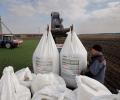
'China reduced its exports of urea to India gradually.' 'In 2020-2021 we imported 28 lakh tonnes of urea which reduced to 16 lakh tonnes in 2022-2023 and that has now reduced to 1 lakh tonnes in 2024-2025.'

The government chose moral persuasion to make people give up subsidies, notes Rahul Khullar.

The combined fertiliser, food and petroleum subsidy budgeted estimate for FY19 is Rs 2.64 trillion, while the revised estimate is Rs 2.66 trillion. If the carrying forward to FY20 does not happen, the revised estimates for the major subsidies could actually cross Rs 3 trillion for the first time ever.

Savings for Indian refiners from purchasing Russian oil have decreased to a third of what they were in the years following Russia's invasion of Ukraine, which triggered global crises, sanctions, and discounted Russian oil seeking buyers. Despite this, savings from importing cheap Russian oil were significant enough to help Indian refiners tide over frozen petrol and diesel pump prices.

'Things may get much worse before they get better,' predicts Ajay Chhibber.

The supplementary demands for grants include a gross additional spending of over Rs 2 lakh crore, which would be matched by savings of over Rs 1.21 lakh crore.

'What the US appears to be doing is to force India to be "the buyer of last resort", on whom their products can be dumped, 1.4 billion people have to eat something, so why not eat American corn?' 'What is exercising the Trump lot is the fact that most of the farms are in solidly Republican Midwestern states: Illinois, Indiana, Kansas, Michigan, Minnesota, Missouri, Nebraska, North Dakota, Ohio, South Dakota, Wisconsin,' points out Rajeev Srinivasan.
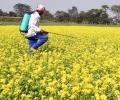
With farm Acts out of the picture, the government may look at reforming the input side of the agriculture sector - regulations and rules that govern seeds, fertilisers and plant chemicals. Sources said such a blueprint, which is aimed at making the life of farmers easier, with quicker approvals but not compromising on quality, is in the works as part of the 100-day agenda of Modi 3.0. Also, ways to administer fertiliser subsidy more effectively and cutting down on leakages and diversions to build on the success of neem-coated urea are being thought of.

'The global situation is not very good.'

Any industrial policy is only as good as how it is applied and the other reforms that support it. This was as true 40 years ago as it is now, points out Debashis Basu.

'You've got to understand it is not easy to die by suicide.' 'People commit suicide only when they lose everything and find no other way to live.'
As the kharif season is setting in, India is scrambling to source fertilisers from the international market. It is set to sign long-term contracts - especially with Morocco and Latin American countries - to ensure steady flow of supplies. "We have to source fertilisers wherever it is available because crops have to be secured.

The outgo for major subsides, is the highest in the first quarter.
Tamil Nadu Chief Minister J Jayalalithaa on Thursday demanded that Union Fertiliser Minister and Dravida Munnetra Kazhagam nominee M K Alagiri should be sacked in connection with the alleged fertiliser subsidy scam.

On March 13, Minister of State for Finance Pankaj Chaudhary had tabled the second batch of supplementary demands for grants in the House amounting to a total of Rs 2,70,508.89 crore.
Already, the government's resources are strained due to various fiscal stimulus and the Survey has separately noted that high growth environment creates scope for partial rollback of these stimuli.

Finance Minister Nirmala Sitharaman on Thursday announced a new job creation scheme by giving subsidy to those establishments that make new hires. The subsidy would be to cover for retirement fund contributions by employees as well as employers for two years, she said. Employees contribution (12 per cent of wages) and employer's contribution (12 per cent of wages) totalling 24 per cent of wages would be given to establishments for two years, she said. Under the Aatmanirbhar Bharat Rozgar Yojana, every Employees' Provident Fund Organisation (EPFO)-registered establishment taking new employees would get this subsidy.

The CBI has registered a case related to the alleged diversion of fertilisers meant for farmers against Agrasen Gehlot, Rajasthan Chief Minister Ashok Gehlot's brother, and 14 others, and carried out searches at his Jodhpur home and 16 other locations in three states, officials said.
Barely a week before the Union Budget for 2010-11, the United Progressive Alliance government on Thursday raised urea prices 10 percent.
The government has decided to give a Rs 3,000-crore (Rs 30-billion) cash subsidy to fertiliser companies and put in another Rs 800 crore (Rs 8 billion) in Air India. Oil marketing companies, though, are unlikely to get any subsidy for the losses they incur on selling cooking fuel at subsidised rates in the current year.

Union finance secretary T V Somanathan recently said the Centre had saved Rs 10,000 crore in FY22 on interest payments after adopting new accounting mechanisms for central government agencies and centrally sponsored schemes (CSS) for state governments. Speaking at an event, Somanathan said due to these, there was an unspent balance of Rs 1.2 trillion with state agencies from CSS as on March 31, 2022. This means this amount will be reduced from the Centre's borrowing for now and it can be considered a short-term saving for the exchequer.
